
Best Digital Marketing Tools for SEO & Growth 2026
Digital marketing tools are software platforms and applications designed to help businesses plan, execute, analyze, and optimize their online marketing efforts. Instead of handling tasks manually, marketers use these tools to streamline workflows, improve accuracy, and scale campaigns faster. From SEO and content creation to email automation and analytics, these tools cover every stage of the customer journey. According to a HubSpot report, over 76% of marketers say using the right tools directly improves campaign performance. In simple terms, digital marketing tools act as the backbone of modern online growth strategies.
Best Digital Marketing Tools (Category-Wise List)
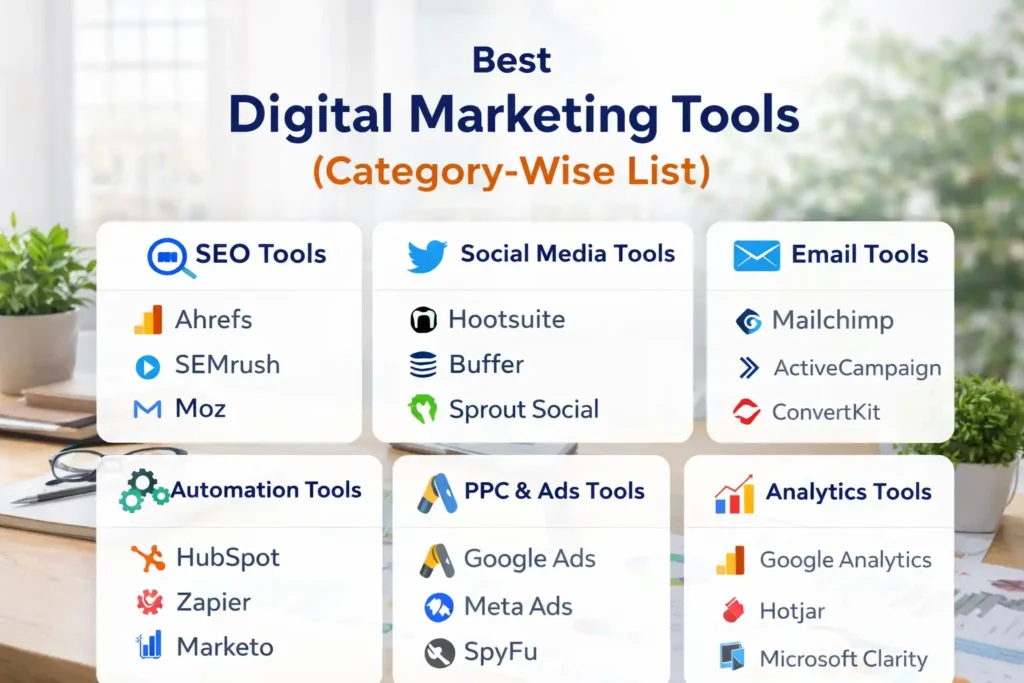
Choosing the right digital marketing tools is not about picking the most popular names. It’s about selecting tools that align with your strategy, budget, and growth stage. Top-performing marketers rely on a combination of specialized tools instead of a single platform. According to Gartner, businesses using integrated marketing stacks see significantly higher campaign performance and customer insights. The right tools help automate tasks, improve targeting, and provide accurate data for decision-making. Below is a curated breakdown of the best digital marketing tools across key categories to help you build a powerful, scalable marketing system.
Best SEO Tools
SEO tools help improve your website’s visibility by optimizing keywords, backlinks, and technical performance. Tools like Ahrefs and SEMrush are widely used for keyword research and competitor analysis, while Google Search Console helps monitor site performance. For technical audits, Screaming Frog is highly effective. Using these tools together ensures better rankings and consistent organic growth.
Best Social Media Marketing Tools
Social media tools help manage content, schedule posts, and track engagement across platforms. Hootsuite and Buffer are popular for scheduling, while Sprout Social offers advanced analytics and reporting. These tools allow businesses to stay consistent, monitor trends, and improve audience engagement without manually managing each platform.
Best Content Marketing Tools
Content marketing tools support research, writing, and optimization to create high-performing content. Surfer SEO helps optimize articles for search engines, while Grammarly improves readability and grammar. For topic research, BuzzSumo is widely used. These tools ensure your content is engaging, SEO-friendly, and aligned with user intent.
Best Email Marketing Tools
Email marketing tools help automate campaigns, segment audiences, and improve engagement. Mailchimp is beginner-friendly, while ActiveCampaign offers advanced automation features. ConvertKit is ideal for content creators and bloggers. These tools help businesses build relationships and achieve higher ROI through personalized email campaigns.
Best PPC & Advertising Tools
PPC tools help manage and optimize paid advertising campaigns. Google Ads is the most widely used platform for search ads, while Meta Ads Manager is essential for social campaigns. Tools like SpyFu help analyze competitor strategies. These tools improve targeting, reduce ad spend waste, and increase conversions.
Best Analytics Tools
Analytics tools provide insights into user behavior, traffic sources, and campaign performance. Google Analytics is the industry standard for tracking website performance. Hotjar helps visualize user interactions, while Microsoft Clarity offers free session recordings. These tools help marketers make data-driven decisions and improve overall performance.
Best Marketing Automation Tools
Automation tools streamline workflows and improve efficiency by handling repetitive tasks. HubSpot is a leading all-in-one solution, while Zapier connects different apps and automates workflows. Marketo is ideal for large businesses. These tools help scale marketing efforts and improve lead nurturing.
Best CRO Tools
CRO tools focus on improving conversions by analyzing and optimizing user behavior. Optimizely allows experimentation with different page versions, while Unbounce helps create high-converting pages. Crazy Egg provides insights into user activity. These tools help businesses convert more visitors without increasing traffic.
Free vs Paid Digital Marketing Tools
Choosing between free and paid digital marketing tools depends on your current needs and long-term goals. Free tools are great for beginners and small businesses, offering essential features to get started. However, paid tools provide advanced capabilities like automation, deeper analytics, and scalability. According to Capterra, businesses using paid marketing tools often achieve faster growth due to improved efficiency and data insights. The smartest approach is to start with free tools and gradually upgrade as your marketing becomes more complex and results-driven.
Best Free Tools for Beginners
Free tools provide a strong starting point for learning and experimenting with digital marketing. Google Analytics and Google Search Console are essential for tracking performance, while Canva helps create visuals easily. Ubersuggest is useful for basic keyword research. These tools offer enough functionality to build a solid foundation.
ROI Comparison (Free vs Paid)
Free tools are cost-effective but limited in features and scalability. Paid tools, on the other hand, offer advanced automation, better data accuracy, and improved performance tracking. Businesses using tools like HubSpot or ActiveCampaign often see higher ROI due to better targeting and personalization. Over time, paid tools typically deliver stronger returns and long-term growth.
How to Choose the Right Digital Marketing Tools
Choosing the right digital marketing tools is critical for building an efficient and scalable marketing strategy. Instead of following trends, businesses should focus on tools that align with their goals, budget, and workflow. The wrong tools can slow down operations, while the right ones can significantly improve performance and ROI. According to a report by G2, companies that carefully select and integrate marketing tools experience higher productivity and better campaign outcomes. The key is to evaluate tools based on usability, integrations, and long-term scalability rather than just features or popularity.
Define Your Marketing Goals
Before selecting any tool, clearly define what you want to achieve. Whether it’s increasing traffic, generating leads, or improving conversions, your goals will determine the tools you need. For example, SEO goals may require Ahrefs, while email growth may rely on Mailchimp. Clear goals prevent unnecessary spending and ensure every tool serves a purpose.
Consider Your Budget
Budget plays a major role in tool selection, especially for startups and small businesses. While premium tools like SEMrush offer advanced features, free tools like Google Analytics can still deliver strong results. Start with essential tools and upgrade as your business grows. A balanced approach helps maintain profitability while scaling efficiently.
Check Integrations & Compatibility
Your tools should work seamlessly together to avoid workflow issues. Integration platforms like Zapier allow different tools to connect and automate tasks. For example, integrating HubSpot with email or analytics tools can streamline data flow. Strong integrations reduce manual work and improve overall efficiency.
Ease of Use & Learning Curve
A powerful tool is useless if your team cannot use it effectively. Always choose tools with a user-friendly interface and good support resources. Platforms like Canva are popular because they are easy to use, even for beginners. Tools with a steep learning curve can slow down productivity and require additional training.
Scalability for Future Growth
As your business grows, your tools should be able to scale with you. Platforms like HubSpot and ActiveCampaign offer scalable features for growing businesses. Choosing scalable tools early prevents the need for frequent switching and ensures long-term efficiency.
💚 You might also like: How to Copy and Paste on Chromebook (Complete Guide 2026)
Must-Have Digital Marketing Tools for Beginners
For beginners, the goal is not to use every tool available but to build a simple and effective toolkit. Starting with a few essential tools helps you understand the basics without feeling overwhelmed. According to HubSpot, marketers who begin with a focused set of tools learn faster and achieve better results. The right beginner tools should be easy to use, cost-effective, and capable of covering core marketing activities like SEO, content creation, and analytics. Below are the must-have tools every beginner should consider when starting digital marketing.
Starter Toolkit (Low Budget Setup)
A basic toolkit should include tools for SEO, analytics, and content creation. Google Analytics tracks performance, Ubersuggest helps with keyword research, and Canva supports visual content creation. These tools are affordable and provide enough functionality to build a strong foundation.
Tools for Small Businesses
Small businesses need tools that balance cost and performance. Mailchimp is great for email marketing, while Buffer helps manage social media. Google Search Console is essential for SEO monitoring. These tools help small businesses grow without heavy investment.
Tools for Freelancers & Agencies
Freelancers and agencies need tools that improve productivity and client management. Trello helps manage tasks, while Ahrefs supports SEO projects. Grammarly ensures content quality. These tools help professionals deliver better results and manage multiple clients efficiently.
💚 You might also like: HHKTHK – A Complete Guide to Its Meaning, Origins, and Digital Influence
Advanced Digital Marketing Tools for Professionals
As businesses scale, they require advanced tools that offer deeper insights, automation, and enterprise-level capabilities. Professional marketers rely on powerful platforms to manage large campaigns, analyze complex data, and optimize performance. According to Salesforce, high-performing marketing teams are more likely to use advanced automation and analytics tools. These tools not only improve efficiency but also enable data-driven decision-making. Below are some of the most important categories of advanced digital marketing tools used by professionals and large organizations.
AI-Powered Marketing Tools
AI tools help automate content creation, personalization, and data analysis. Platforms like Jasper and Copy.ai assist in generating content quickly. AI tools improve efficiency and help marketers scale content production without compromising quality.
Enterprise-Level Platforms
Enterprise tools are designed for large-scale operations with advanced features. Salesforce and Marketo offer robust automation, analytics, and customer management capabilities. These platforms are ideal for businesses managing complex marketing campaigns.
Data-Driven Marketing Tools
Data-driven tools help analyze customer behavior and campaign performance. Google Analytics and Tableau provide deep insights into data. These tools allow marketers to make informed decisions and optimize strategies based on real performance metrics.
💚 You might also like: What Is Haxillzojid54? A Detailed Breakdown
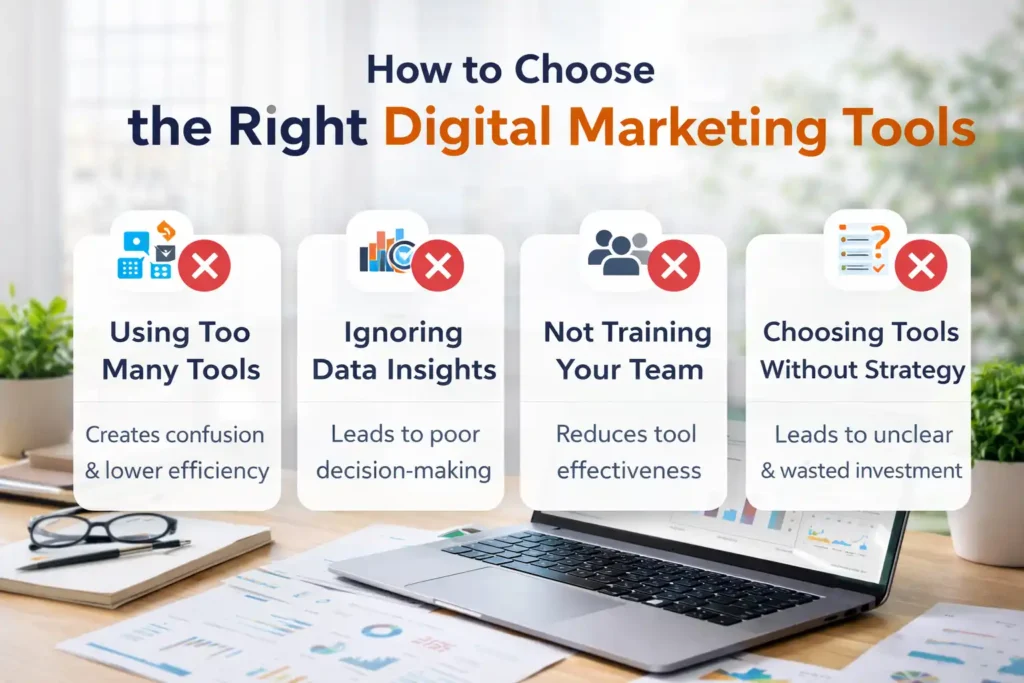
Common Mistakes to Avoid When Using Marketing Tools
While digital marketing tools can significantly improve performance, using them incorrectly can lead to wasted time and resources. Many businesses invest in tools without a clear strategy, resulting in poor results. According to a study by HubSpot, over 40% of marketers feel overwhelmed by the number of tools they use. Avoiding common mistakes can help you maximize the value of your tools and achieve better outcomes. Understanding these pitfalls ensures that your marketing stack remains efficient, focused, and results-driven.
Using Too Many Tools at Once
Using too many tools can lead to confusion and lower overall efficiency. Instead of improving productivity, it often leads to complexity and overlapping features. Focus on a few essential tools like Ahrefs or HubSpot that cover multiple functions effectively.
Ignoring Data Insights
Many marketers collect data but fail to use it effectively. Tools like Google Analytics provide valuable insights that can improve campaigns. Ignoring data leads to missed opportunities and poor decision-making. Always analyze and act on the data your tools provide.
Not Training Your Team
Even the best tools require proper training to be effective. Without training, teams may not use tools to their full potential. Platforms like HubSpot offer learning resources, but businesses must invest time in training to maximize results.
Choosing Tools Without Strategy
Selecting tools without a clear strategy often leads to wasted investment. Businesses should first define their goals and then choose tools accordingly. For example, using SEMrush without an SEO strategy will not deliver results. Always align tools with your marketing objectives.
💚 You might also like: What is pizmotidxizvou? An Introduction to a Digital Mystery
Latest Trends in Digital Marketing Tools (2026)
Digital marketing tools are evolving rapidly, driven by advancements in technology and changing consumer behavior. In 2026, trends like AI, automation, and personalization are shaping the future of marketing. According to Statista, the adoption of AI in marketing continues to grow significantly each year. Businesses that stay updated with these trends gain a competitive advantage and improve their marketing performance. Understanding these trends helps marketers adapt quickly and use the latest tools to stay ahead in an increasingly competitive digital landscape.
AI & Automation in Marketing
AI and automation are transforming how marketing campaigns are executed. Tools like HubSpot and Zapier automate repetitive tasks and improve efficiency. This allows marketers to focus on strategy and creativity rather than manual work.
Predictive Analytics
Predictive analytics uses data to forecast future outcomes and customer behavior. Tools like Google Analytics and Tableau help identify trends and make data-driven decisions. This improves targeting and campaign performance.
Personalization at Scale
Personalization tools allow businesses to deliver tailored experiences to users. Platforms like ActiveCampaign and Salesforce help create personalized campaigns based on user behavior. This help to gain higher engagement and conversions.
No-Code & Low-Code Tools
No-code tools make it easier for non-technical users to build and manage campaigns. Platforms like Webflow and Zapier allow users to create workflows without coding. This trend is making digital marketing more accessible and efficient.
💚 You might also like: OpenFuture World: A Comprehensive Guide
How Digital Marketing Tools Work Together (Tech Stack Guide)
Digital marketing tools deliver the best results when they work together as part of a unified system. Instead of using isolated tools, businesses should focus on building an integrated marketing stack. A well-structured tech stack improves efficiency, ensures smooth data flow, and enhances decision-making. According to Salesforce, companies with integrated systems see better customer insights and higher ROI. Understanding how tools connect and support each other is essential for creating a scalable and high-performing marketing strategy.
Building a Complete Marketing Stack
A complete marketing stack includes tools for SEO, content, analytics, and automation. For example, combining Ahrefs, Google Analytics, and HubSpot creates a strong foundation. Each tool plays a specific role in improving marketing performance.
Tool Integrations & Workflow Automation
Integrations help different tools to work in one place seamlessly. Platforms like Zapier connect tools and automate workflows. For example, leads captured through forms can automatically be added to a CRM like HubSpot. This improves the efficiency and reduces the manual workload.
Example of a High-Performing Stack
A high-performing stack might include SEMrush for SEO, Mailchimp for email marketing, Google Analytics for tracking, and HubSpot for automation. This combination ensures a balanced and effective marketing system.
FAQs About Digital Marketing Tools
What are the best digital marketing tools for beginners?
Beginners should start with simple and reliable tools that cover essential marketing functions. Google Analytics helps track website performance, while Canva is great for creating visuals. For SEO, Ubersuggest is a good starting point, and Mailchimp works well for email campaigns. These tools are easy to use and budget-friendly.
Which tools are free?
Many powerful digital marketing tools offer free versions with useful features. Google Search Console and Google Analytics are completely free and essential for tracking performance. Canva offers a free plan for design, while Ubersuggest provides limited free keyword research. These tools are ideal for beginners or small businesses.
What tools do agencies use?
Agencies use advanced tools to manage multiple clients and campaigns efficiently. Ahrefs and SEMrush are widely used for SEO and competitor analysis. HubSpot helps manage leads and automation, while Trello is used for task management. These tools help agencies scale operations and deliver consistent results.
Are paid tools worth it?
Paid tools are worth it when your business reaches a stage where advanced features and automation are required. Tools like SEMrush and Ahrefs provide deeper insights than free tools. Similarly, ActiveCampaign improves email automation. These tools help save time, improve accuracy, and deliver better ROI in the long run.
How many tools do I need?
The number of tools you need depends on your business size and goals. Beginners can start with 3 to 5 tools like Google Analytics, Canva, and Mailchimp. As your business grows, you can add advanced tools like HubSpot or Ahrefs. Focus on quality over quantity.
Conclusion
Digital marketing tools play a crucial role in helping businesses grow, automate processes, and make data-driven decisions. From SEO and content creation to analytics and automation, the right tools can significantly improve efficiency and results. The key takeaway is not to rely on too many tools but to choose the ones that align with your goals and strategy. Whether you are a beginner or a professional, building the right marketing stack is essential for long-term success. As the digital landscape evolves, using the right tools will give you a clear competitive advantage.
✨ Your smarter feed is one tap away. Follow AI Mastars.