
AI vs Human Creativity: Who Wins in the Age of Artificial Intelligence?
Introduction
Today, AI can write articles, generate artwork, compose music, create videos, and even assist in product design. As these capabilities continue to improve, a major question has emerged: can AI truly compete with human creativity?
The debate between AI and human creativity is no longer theoretical. Businesses, artists, marketers, educators, and technology experts are already using AI-powered tools to enhance creative workflows. However, creativity is about more than producing content quickly. It also involves emotion, imagination, intuition, and personal experiences.
Research from the World Economic Forum continues to identify creative thinking as one of the most important future workplace skills. At the same time, advancements in artificial intelligence are demonstrating that machines can contribute to creative processes in ways that were unimaginable a decade ago.
answer is more complex than choosing one side. Understanding the strengths and limitations of both can help us see how creativity will evolve in the future.
Understanding Creativity: What Does It Really Mean?
Creativity is the ability to produce original, valuable, and meaningful ideas. It involves combining knowledge, imagination, and problem-solving skills to create something new. Creativity extends beyond art and entertainment. Scientists use creativity to make discoveries, entrepreneurs use it to build businesses, and engineers use it to develop innovative technologies. What makes creativity unique is its connection to human thought and experience. It often emerges when people explore new perspectives or solve challenges in unexpected ways. In today’s digital economy, creativity remains a critical skill because innovation drives progress across industries and societies worldwide.
Types of Creativity
Creativity exists in several forms, including artistic creativity, scientific innovation, business creativity, and everyday problem-solving. Each form requires different thinking approaches but shares the common goal of producing something original and useful. These variations demonstrate that creativity influences nearly every aspect of human life.
💚 You might also like: https://aimastars.com/build-a-high-converting-marketing-funnel-easy-guide/
Why Creativity Matters Today
Modern organizations depend on creativity to remain competitive. Companies that encourage innovation often adapt more quickly to changing markets. As automation handles routine tasks, creative thinking becomes increasingly valuable because it enables people to develop unique solutions and generate fresh opportunities.
How AI Creates Content, Art, Music, and Ideas
Artificial intelligence creates content by learning patterns from massive datasets and using those patterns to generate new outputs. Through machine learning and deep learning technologies, AI can produce articles, artwork, music compositions, video content, and marketing materials. Generative AI models analyze billions of data points to predict what content should come next based on user prompts. This allows AI systems to generate impressive creative outputs within seconds. Businesses increasingly use AI because it improves efficiency, reduces production time, and helps generate ideas at scale. However, AI creativity operates differently from human creativity because it depends heavily on existing data.
Technologies Behind AI Creativity
AI creativity relies on advanced technologies such as machine learning, neural networks, natural language processing, and generative models. These systems identify relationships within large datasets and use statistical predictions to create new content. The quality of AI-generated outputs often depends on the quantity and quality of training data.
The Growth of Generative AI
The popularity of generative AI has increased dramatically since the launch of advanced language and image-generation tools. Organizations across industries now use AI to create marketing campaigns, visual designs, social media content, and business reports, demonstrating its growing influence on creative work.
Human Creativity
Human creativity originates from personal experiences, emotions, imagination, and cultural understanding. Unlike artificial intelligence, humans create based on feelings, memories, aspirations, and individual perspectives. These elements allow people to produce work that reflects genuine emotion and unique life experiences. Great literature, paintings, inventions, and musical compositions often emerge from deeply personal journeys. Human creativity also benefits from intuition, allowing individuals to make connections that are not always logical or data-driven.
Emotion as a Creative Force
Emotions play a significant role in creative expression. Joy, sadness, curiosity, fear, and passion often inspire groundbreaking ideas. These emotional influences help creators connect with audiences on a deeper level and produce work that feels authentic and meaningful.
The Influence of Life Experiences
Every person’s experiences shape their perspective and influence their creative choices. Different cultures, backgrounds, relationships, and challenges contribute to unique viewpoints. This diversity of experience allows humans to generate ideas that machines cannot fully replicate.
💚 You might also like: https://aimastars.com/trending-products-to-sell-online-2026/
AI Creativity vs Human Creativity: Key Differences
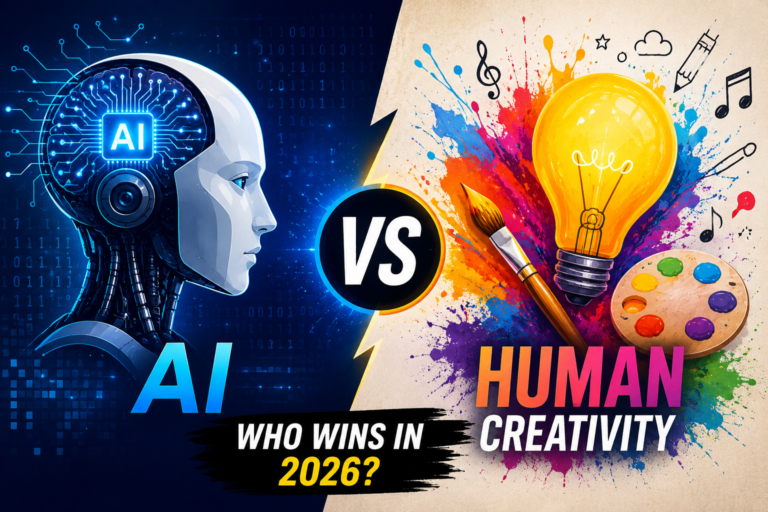
Although both AI and humans can produce creative outputs, their methods differ significantly. AI relies on data, algorithms, and pattern recognition, while humans depend on emotions, experiences, imagination, and intuition. AI can generate content rapidly and consistently, making it highly efficient for repetitive creative tasks. Human creativity, however, often involves deeper meaning, emotional nuance, and original thinking that extends beyond existing patterns. AI typically creates by recombining learned information, whereas humans can challenge assumptions and develop entirely new concepts. Understanding these differences helps clarify why AI and human creativity are often complementary rather than directly competitive.
Data-Driven vs Experience-Driven Creation
AI generates content based on patterns found in training data. Humans create from personal experiences and emotional understanding. This fundamental difference influences how originality, storytelling, and innovation emerge within each creative process.
Speed Versus Meaning
AI can create content in seconds, while human creativity may require extensive thought and refinement. However, human-created work often carries deeper context, emotional depth, and symbolic meaning that resonate strongly with audiences.
Areas Where AI Outperforms Human Creativity
Artificial intelligence excels in tasks that require speed, consistency, scalability, and pattern analysis. AI can generate thousands of content variations, analyze market trends, and produce creative assets in a fraction of the time required by humans. In digital marketing, AI helps create headlines, advertisements, social media posts, and visual concepts efficiently. AI also identifies patterns within large datasets that may be impossible for humans to detect manually. These capabilities make AI particularly valuable for brainstorming, automation, and content production. As organizations seek greater productivity, AI continues to demonstrate significant advantages in specific creative applications.
Rapid Content Generation
AI can create articles, graphics, product descriptions, and marketing materials almost instantly. This speed enables businesses to produce large volumes of content while reducing costs and increasing operational efficiency.
Pattern Recognition and Trend Analysis
Machine learning systems excel at identifying trends across massive datasets. This capability helps marketers, designers, and businesses anticipate customer preferences and develop content strategies based on data-driven insights.
💚 You might also like: https://aimastars.com/ai-agents-vs-chatbots/
Areas Where Humans Still Have the Creative Advantage
Despite AI’s capabilities, humans maintain important creative advantages that technology has not fully replicated. Emotional intelligence, empathy, cultural awareness, ethical reasoning, and visionary thinking remain uniquely human strengths. People can interpret complex social contexts, understand subtle emotional cues, and create work that reflects personal meaning. Human creators also challenge conventional thinking and imagine possibilities that do not exist within historical data. These abilities contribute to groundbreaking innovations and artistic masterpieces. While AI can assist the creative process, many experts believe human imagination remains essential for producing truly transformative ideas and experiences.
Emotional Storytelling
Stories that inspire, motivate, and connect people often draw upon authentic emotions and lived experiences. Human creators understand emotional complexity in ways that enable them to craft compelling narratives and meaningful artistic expressions.
Visionary Innovation
Many groundbreaking inventions emerged because individuals imagined possibilities beyond existing knowledge. Human creativity frequently involves taking risks, questioning assumptions, and exploring ideas that have no historical precedent.
Real-World Examples of AI and Human Creativity in Action
The interaction between AI and human creativity is already visible across numerous industries. AI-generated artwork has been displayed in galleries, while musicians use AI tools to experiment with new sounds and compositions. Marketing agencies rely on AI for content generation and campaign optimization. At the same time, human creators continue producing award-winning films, books, and artistic works that demonstrate emotional depth and originality. The most successful examples often involve collaboration rather than competition. By combining AI’s efficiency with human imagination, creators can enhance productivity while maintaining authenticity and artistic value.
AI-Assisted Creative Projects
Designers, writers, and musicians increasingly use AI as a creative assistant. AI can generate concepts, suggest improvements, and automate repetitive tasks, allowing professionals to focus on higher-level creative decisions.
Human Creativity in Masterpieces
Great artistic achievements often reflect personal vision and emotional expression. While AI can imitate certain styles, it cannot fully replicate the human experiences that inspire truly memorable creative works.
Can AI Truly Be Creative or Is It Just Mimicking Humans?
One of the most debated questions in technology concerns whether AI can genuinely be creative. Critics argue that AI merely recombines information learned from existing datasets and therefore lacks true originality. Supporters suggest that producing novel and useful outputs may qualify as a form of creativity. Researchers continue exploring this issue, but many agree that AI operates differently from human creative processes. While AI can generate impressive results, it lacks consciousness, self-awareness, and emotional experiences. These limitations suggest that AI creativity may be better understood as computational creativity rather than the deeply personal creativity associated with humans.
The Argument for AI Creativity
Supporters believe AI demonstrates creativity because it generates outputs that appear novel and useful. In many cases, AI can produce ideas that surprise even its developers, creating outcomes that seem innovative.
The Argument Against AI Creativity
Critics emphasize that AI lacks intentions, emotions, and personal experiences. Since creativity often involves subjective understanding and meaning, many researchers argue that AI cannot fully replicate genuine human creativity.
The Future of Creativity: Collaboration Between AI and Humans
The future of creativity is likely to involve collaboration rather than competition. AI can automate repetitive tasks, generate ideas, and analyze large amounts of information, while humans provide imagination, emotional intelligence, and strategic thinking. This partnership enables creators to work more efficiently without sacrificing originality. Many industries already use AI-assisted workflows to improve productivity and innovation. As technology advances, professionals who learn to combine AI tools with human creativity may gain significant advantages. The most successful creators of the future will likely be those who understand how to leverage both technological capabilities and uniquely human strengths.
AI as a Creative Partner
Instead of replacing creators, AI increasingly serves as a tool that supports brainstorming, research, and content production. This collaborative approach allows humans to focus on creative direction and decision-making.
Skills Needed in the AI Era
Future professionals will benefit from combining creative thinking with technological literacy. Skills such as storytelling, critical thinking, emotional intelligence, and AI tool proficiency will become increasingly valuable.
💚 You might also like: https://aimastars.com/best-ai-coding-assistants-2026/
Who Wins? The Final Verdict on AI vs Human Creativity
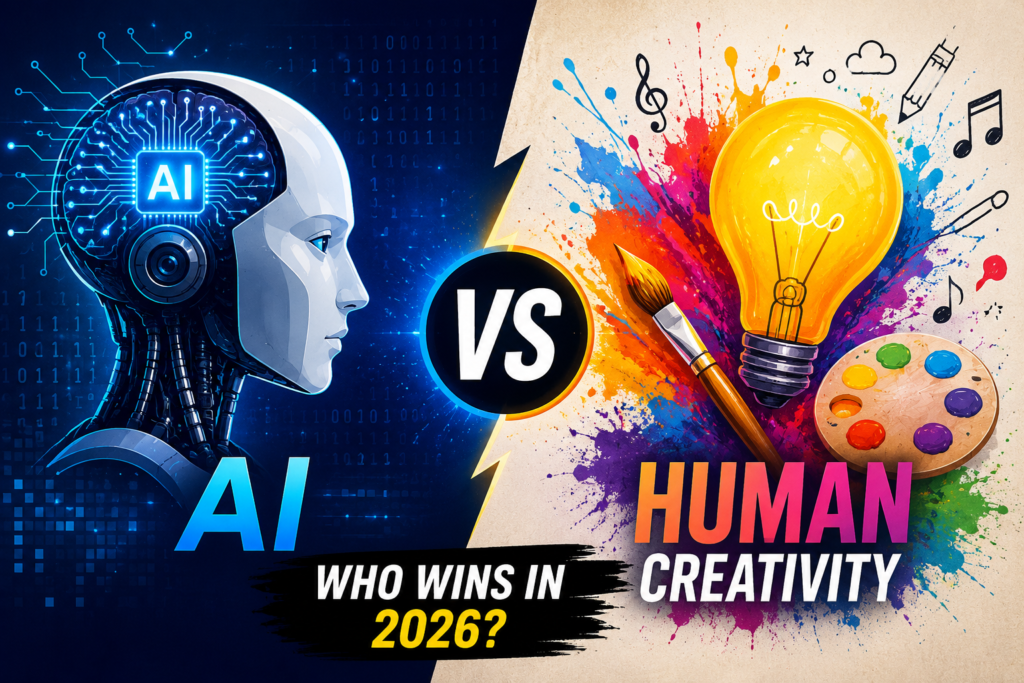
The debate between AI and human creativity does not have a simple winner. AI excels in speed, scalability, data analysis, and content generation, making it an incredibly powerful creative tool. Humans, however, possess emotional intelligence, imagination, empathy, and personal experiences that shape truly meaningful creative work. Rather than replacing human creativity, AI is expanding what creators can achieve. The most effective approach is not choosing one over the other but combining their strengths. As technology continues evolving, the future of creativity will likely be defined by collaboration between artificial intelligence and human imagination.
Strengths of Both Sides
AI offers efficiency, consistency, and analytical power, while humans contribute originality, emotional depth, and visionary thinking. Together, these strengths create opportunities for innovation that neither could achieve alone.
The Real Winner
The real winner may be collaboration itself. By combining human creativity with AI capabilities, individuals and organizations can unlock new possibilities for innovation, productivity, and artistic expression.
Frequently Asked Questions
Is AI more creative than humans?
AI can generate creative outputs quickly and efficiently, but human creativity remains superior in emotional depth, imagination, and original thinking.
Can AI replace human artists and writers?
AI can assist artists and writers but is unlikely to fully replace them because creative work often depends on personal experiences and emotional understanding.
What are the limitations of AI creativity?
AI lacks consciousness, emotions, self-awareness, and real-world experiences. These limitations affect its ability to create truly meaningful and original work.
How does AI generate creative content?
AI analyzes large datasets, identifies patterns, and generates outputs using machine learning and predictive algorithms.
Will AI and humans work together in the future?
Yes. Most experts believe the future of creativity will involve collaboration between AI tools and human creators rather than direct competition.
💚 You might also like: https://aimastars.com/ai-powered-threat-detection-systems/
Conclusion
The discussion surrounding AI versus human creativity reflects a broader conversation about the future of innovation. Artificial intelligence has already transformed creative industries by increasing efficiency and expanding creative possibilities. However, human creativity continues to hold unique advantages rooted in emotion, imagination, empathy, and lived experience.
While AI can generate content, analyze trends, and automate creative tasks, it cannot fully replicate the human ability to assign meaning, express emotions, and envision entirely new possibilities. The future is unlikely to be a contest where one side defeats the other. Instead, it will be a partnership where AI enhances human capabilities and humans guide technology toward meaningful outcomes.
Ultimately, the greatest creative breakthroughs of the future may come not from AI alone or humans alone, but from the powerful combination of both.
✨ Love this energy? Get more, follow AI Mastars.