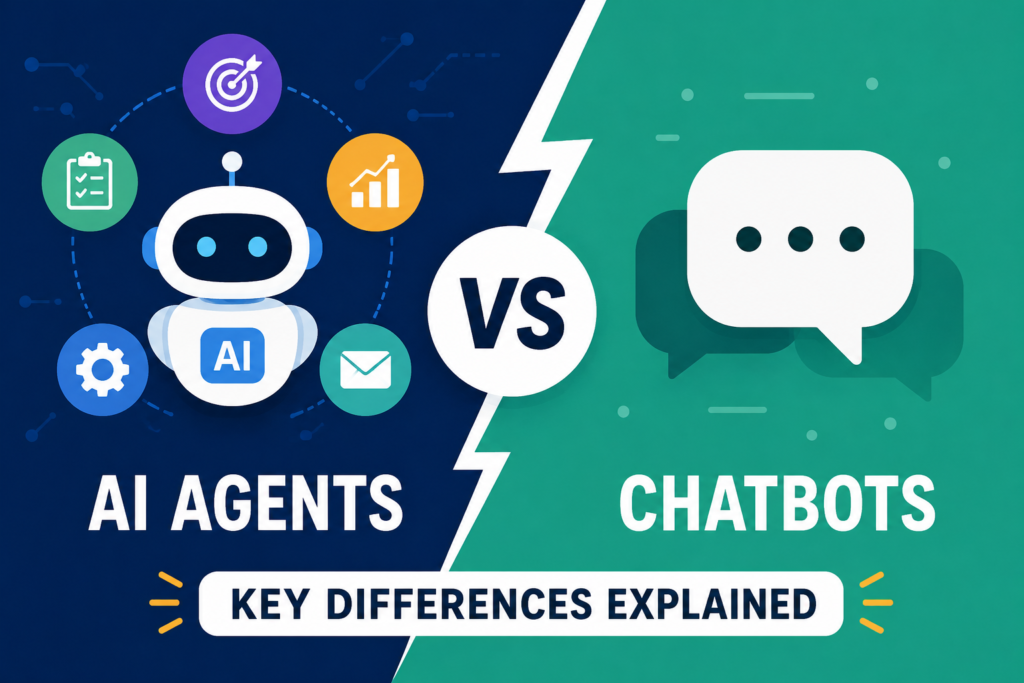

AI Agents vs Chatbots: Key Differences Explained
Introduction
Artificial intelligence is transforming the way businesses interact with customers and automate tasks. Two technologies leading this shift are AI chatbots and AI agents. While many people use these terms interchangeably, they are not the same. Both rely on artificial intelligence, but their capabilities, autonomy, and decision-making processes differ significantly.
Traditional chatbots are designed to respond to user queries and follow predefined workflows. AI agents, on the other hand, can understand goals, make decisions, execute tasks, and adapt based on changing circumstances. As organizations increasingly invest in automation, understanding the difference between AI agents and chatbots has become essential.
According to the IBM Global AI Adoption Index, businesses continue to expand AI deployments across customer service, operations, and workflow automation. This growing adoption highlights the importance of selecting the right AI solution for specific business needs.
In this guide, we will explore AI agents vs chatbots, their core differences, use cases, advantages, limitations, and future potential.
💚 You might also like:https://aimastars.com/6-best-ai-resume-builders-for-faster-job-success/
What Are AI Chatbots?
AI chatbots are software applications designed to simulate human conversations through text or voice interactions. They help users find information, solve common problems, and complete simple tasks without human intervention. Modern chatbots use natural language processing (NLP) to understand user inputs and generate relevant responses. They are commonly used in customer support, online shopping, banking, and healthcare environments. Unlike AI agents, chatbots typically operate within predefined boundaries and focus on conversation-based assistance. Their primary purpose is to answer questions efficiently while improving customer experience and reducing operational workloads for businesses.
How AI Chatbots Work
AI chatbots use natural language processing, machine learning, and conversational AI models to interpret user messages. When a user submits a query, the chatbot identifies intent, analyzes keywords, and retrieves an appropriate response. Advanced chatbots can maintain short-term context during conversations, allowing more natural interactions. However, their capabilities are usually limited to predefined tasks and workflows.
Common Types of Chatbots
Chatbots generally fall into two categories: rule-based chatbots and AI-powered chatbots. Rule-based systems follow scripted responses and decision trees. AI-powered chatbots use machine learning and language models to understand context and generate dynamic responses. Hybrid chatbots combine both approaches, offering structured guidance while maintaining conversational flexibility for users.
Popular Chatbot Examples
Several well-known chatbot examples are used across industries today. Customer support bots on websites handle frequently asked questions and service requests. Virtual assistants such as Siri and Google Assistant perform conversational tasks. E-commerce chatbots assist shoppers with product recommendations, order tracking, and purchase-related inquiries, improving customer engagement and satisfaction.
💚 You might also like:https://aimastars.com/6-best-ai-resume-builders-for-faster-job-success/
What Are AI Agents?
AI agents represent a more advanced form of artificial intelligence designed to achieve goals rather than simply answer questions. They can analyze information, make decisions, perform actions, and adapt to changing environments with minimal human involvement. Unlike chatbots, which primarily focus on conversations, AI agents are task-oriented systems capable of executing complex workflows. They often interact with multiple tools, databases, and software applications to complete objectives. As organizations seek greater automation, AI agents are becoming valuable solutions for productivity, research, operations management, software development, and intelligent decision-making across industries worldwide.
How AI Agents Operate
AI agents operate by observing their environment, interpreting data, making decisions, and executing actions to achieve defined goals. They can break complex objectives into smaller tasks and determine the most effective sequence of actions. This ability enables AI agents to work independently while adapting their behavior based on real-time information and feedback.
Core Components of an AI Agent
An AI agent typically includes perception systems, reasoning mechanisms, memory functions, planning capabilities, and action tools. These components allow the agent to understand situations, retain information, evaluate options, and perform tasks. Advanced agents can also learn from previous experiences, improving their effectiveness and decision-making over time.
Popular AI Agent Examples
Examples of AI agents include autonomous research assistants, workflow automation platforms, coding assistants, and intelligent business systems. These tools can analyze large datasets, generate reports, schedule activities, and execute multi-step tasks. Modern AI agents are increasingly used in software development, marketing automation, customer operations, and enterprise productivity environments.
AI Agents vs Chatbots: Quick Comparison Overview
The comparison between AI agents and chatbots often centers on autonomy, intelligence, and task execution. While both technologies leverage artificial intelligence, their objectives differ significantly. Chatbots focus on responding to conversations and providing information. AI agents focus on achieving outcomes through planning, reasoning, and action. A chatbot may answer a customer question, while an AI agent can resolve the issue by accessing systems and completing required tasks. Understanding these distinctions helps organizations choose solutions that align with operational goals, customer expectations, and automation requirements in an increasingly AI-driven business environment.
Definition Comparison
A chatbot is a conversational system designed to interact with users through text or voice. An AI agent is an autonomous system capable of reasoning, planning, and taking actions to achieve objectives. While chatbots primarily communicate, AI agents actively work toward completing goals and solving problems beyond conversation.
Purpose and Capabilities
Chatbots are designed to provide information, answer questions, and guide users through predefined interactions. AI agents are built to perform actions, automate workflows, and accomplish specific objectives. Their broader capabilities allow them to handle more complex tasks that require decision-making, planning, and adaptive behavior.
User Interaction Style
Chatbots rely heavily on direct user interaction and typically respond when prompted. AI agents can operate proactively by initiating actions without constant human input. This distinction makes AI agents more suitable for automation-heavy environments where independent decision-making and continuous task management are essential.
Key Differences Between AI Agents and Chatbots
The difference between AI agents and chatbots becomes clear when examining their autonomy, intelligence, and operational scope. Chatbots are reactive systems that respond to user inputs. AI agents are proactive systems capable of pursuing goals independently. They can reason through complex situations, retain contextual information, and execute multiple tasks across connected platforms. Research from industry analysts suggests that autonomous AI technologies are expected to play a growing role in enterprise automation over the coming years. Understanding these distinctions enables businesses to implement solutions that maximize efficiency, productivity, and customer satisfaction.
💚 You might also like:https://aimastars.com/best-300-smartphones-for-gaming-camera-2026/
Autonomy and Decision-Making
Chatbots generally follow predefined instructions and depend on user prompts. AI agents possess greater autonomy and can make decisions based on available information and objectives. This capability allows them to handle dynamic situations, prioritize tasks, and adjust strategies without requiring continuous human guidance throughout the process.
Goal-Oriented Behavior
A chatbot focuses on answering questions and maintaining conversations. An AI agent focuses on achieving specific outcomes. Instead of simply providing instructions, the agent can execute tasks necessary to reach a goal. This goal-driven approach makes AI agents valuable for workflow automation and operational efficiency.
Context Awareness and Memory
Most chatbots maintain limited conversational memory during interactions. AI agents often use advanced memory systems that allow them to retain information across sessions. This persistent context improves decision-making, personalization, and task execution while enabling the agent to adapt based on previous experiences and outcomes.
Learning and Adaptation
Modern AI agents can continuously learn from interactions, outcomes, and environmental changes. While some AI-powered chatbots also improve through machine learning, agents generally possess greater adaptability. This enables them to optimize processes, refine strategies, and enhance performance as they encounter new situations over time.
Multi-Step Task Execution
Chatbots usually handle single interactions or straightforward workflows. AI agents can execute multi-step tasks involving research, planning, analysis, and action. For example, an AI agent may gather information, evaluate alternatives, generate recommendations, and complete actions without requiring multiple user instructions throughout the workflow.
How AI Chatbots Work in Real-World Business Applications
AI chatbots have become essential tools for businesses looking to improve customer experiences while reducing operational costs. They provide instant support, answer common questions, and guide users through routine processes. According to IBM, businesses increasingly use conversational AI to enhance service efficiency and customer engagement. Chatbots are available around the clock, making them valuable for organizations serving global audiences. Their ability to handle large volumes of interactions simultaneously helps companies scale customer support operations without significantly increasing staffing requirements. This combination of efficiency, accessibility, and automation continues to drive chatbot adoption across industries.
💚 You might also like:https://aimastars.com/best-ai-automation-software-for-small-businesses/
Customer Support
Customer support is one of the most common chatbot applications. Businesses use chatbots to answer frequently asked questions, troubleshoot basic issues, and direct customers to appropriate resources. By automating routine inquiries, organizations can reduce response times while allowing human support teams to focus on more complex customer concerns and personalized assistance.
Lead Generation
Chatbots play a significant role in lead generation by engaging website visitors and collecting valuable information. They can qualify prospects, ask targeted questions, and recommend relevant products or services. This automated engagement helps businesses identify potential customers more efficiently while creating a smoother experience for users exploring purchasing options.
FAQ Automation
Many organizations deploy chatbots specifically for FAQ automation. Instead of requiring users to search through knowledge bases, chatbots provide instant answers to common questions. This approach improves user satisfaction, reduces support ticket volumes, and ensures consistent information delivery across multiple customer interaction channels.
E-commerce Assistance
In e-commerce environments, chatbots help customers discover products, compare options, track orders, and receive personalized recommendations. Their ability to provide immediate assistance improves shopping experiences and supports purchasing decisions. As online retail competition increases, chatbot-driven customer engagement has become an important component of digital commerce strategies.
How AI Agents Are Transforming Modern Workflows
AI agents are reshaping business operations by automating complex tasks that traditionally required significant human involvement. Unlike chatbots, which primarily facilitate conversations, AI agents actively execute workflows, analyze information, and make decisions based on objectives. Research from McKinsey suggests that generative AI and autonomous systems have the potential to significantly improve productivity across industries. Organizations are increasingly adopting AI agents to streamline operations, reduce manual workloads, and enhance decision-making. Their ability to integrate with multiple tools and systems makes them valuable assets in modern digital transformation initiatives and enterprise automation strategies.
Business Process Automation
AI agents can automate repetitive business processes such as data entry, report generation, scheduling, and workflow management. By handling these tasks independently, they reduce administrative burdens and improve operational efficiency. This allows employees to focus on strategic initiatives while ensuring routine processes are completed accurately and consistently.
💚 You might also like:https://aimastars.com/build-a-high-converting-marketing-funnel-easy-guide/
Personal Productivity Assistance
Many professionals use AI agents as productivity assistants. These systems can organize schedules, prioritize tasks, summarize information, and manage daily workflows. Their ability to handle multiple responsibilities simultaneously helps users save time, improve organization, and maintain focus on high-value activities throughout the workday.
Data Analysis and Research
AI agents excel at analyzing large datasets and conducting research tasks. They can gather information from multiple sources, identify patterns, generate insights, and create summaries. This capability helps businesses make informed decisions faster while reducing the time traditionally required for manual research and analysis.
Software Development and Coding Tasks
In software development, AI agents assist with code generation, debugging, testing, and documentation. They can automate repetitive development tasks and provide recommendations for optimization. This support helps developers improve productivity while accelerating project timelines and reducing the likelihood of common programming errors.
Benefits and Limitations of AI Chatbots
AI chatbots offer numerous advantages for businesses seeking scalable customer interaction solutions. Their ability to provide instant responses, maintain consistent communication, and operate continuously makes them valuable across various industries. However, chatbots also have limitations that organizations must consider. While modern conversational AI systems are increasingly sophisticated, they may struggle with highly complex requests or unexpected situations.Businesses that align chatbot capabilities with appropriate use cases often achieve the best results while avoiding unrealistic expectations about automation performance.
Major Advantages
Chatbots provide immediate customer support, reduce operational costs, and improve service availability. They can handle large volumes of interactions simultaneously without performance degradation. These benefits make them particularly useful for businesses seeking scalable solutions that enhance customer experiences while maintaining efficiency and reducing staffing requirements.
Common Challenges
Despite their advantages, chatbots may struggle with complex conversations, emotional understanding, and unique customer situations. Limited contextual awareness can sometimes lead to inaccurate responses. Organizations must regularly update chatbot knowledge bases and workflows to maintain effectiveness and ensure users receive relevant and accurate information.
When Chatbots Are the Better Choice
Chatbots are ideal for straightforward interactions involving customer service, FAQs, appointment scheduling, and basic information retrieval. When tasks primarily require communication rather than autonomous decision-making, chatbots offer a cost-effective and efficient solution that delivers reliable results without unnecessary complexity.
Benefits and Limitations of AI Agents
AI agents provide advanced automation capabilities that extend far beyond conversational interactions. Their ability to reason, plan, and execute actions makes them powerful tools for organizations seeking intelligent workflow automation. However, these capabilities often require greater computational resources, implementation effort, and oversight compared to traditional chatbots. As AI agents become more sophisticated, businesses must balance their potential benefits with practical considerations related to cost, governance, and operational complexity. Understanding these trade-offs helps organizations determine whether AI agents align with their strategic goals and technical requirements.
Major Advantages
AI agents can automate complex workflows, make informed decisions, and adapt to changing conditions. Their ability to execute multi-step tasks improves productivity and operational efficiency. These capabilities enable businesses to streamline processes, reduce manual intervention, and achieve greater scalability across diverse operational environments.
Common Challenges
Implementing AI agents can be more complex than deploying chatbots. Organizations may face challenges related to integration, monitoring, security, and governance. Additionally, autonomous decision-making requires careful oversight to ensure agents operate responsibly and align with business objectives and compliance requirements.
💚 You might also like: https://aimastars.com/how-to-create-ai-chatbots-for-whatsapp-websites/
When AI Agents Are the Better Choice
AI agents are most effective when tasks involve planning, reasoning, and independent execution. Businesses seeking workflow automation, advanced research capabilities, or intelligent decision support often benefit from AI agents. Their ability to achieve outcomes rather than simply provide information distinguishes them from traditional chatbot solutions.
AI Agent vs Chatbot: Which One Should Your Business Choose?
Choosing between an AI agent and a chatbot depends on business objectives, operational requirements, and available resources. Organizations focused on customer communication may find chatbots sufficient for their needs. Those seeking advanced automation and intelligent task execution may benefit more from AI agents. The decision should consider factors such as complexity, scalability, integration requirements, and expected outcomes. As artificial intelligence continues to evolve, many businesses are adopting hybrid approaches that combine chatbot interactions with agent-driven automation. This strategy often delivers the advantages of both technologies while maximizing overall efficiency and customer satisfaction.
Factors to Consider
Businesses should evaluate objectives, workflows, customer expectations, and technical capabilities before selecting a solution. Understanding operational challenges and desired outcomes helps determine whether conversational support or autonomous task execution provides the greatest value for a specific use case.
Budget and Resource Requirements
Chatbots are generally less expensive to implement and maintain than AI agents. AI agents often require advanced infrastructure, integrations, and monitoring systems. Organizations should assess budgets, technical expertise, and long-term scalability requirements before making investment decisions related to AI adoption.
Industry-Specific Use Cases
Different industries benefit from different AI solutions. Retail businesses often leverage chatbots for customer engagement, while technology firms may utilize AI agents for workflow automation and development tasks. Matching technology capabilities to industry requirements improves implementation success and return on investment.
Decision-Making Framework
A structured evaluation process helps businesses choose the right solution. Organizations should assess goals, complexity, resource availability, and automation requirements. This framework ensures AI investments align with operational priorities while supporting long-term growth and efficiency objectives.
The Future of AI Agents and Chatbots
The future of artificial intelligence will likely involve increasing collaboration between chatbots and AI agents. Advances in large language models, machine learning, and automation technologies continue to expand their capabilities. According to the Stanford AI Index, AI adoption and investment remain strong across industries, driving innovation in intelligent systems. Future solutions may combine conversational interfaces with autonomous decision-making to create more capable digital assistants. As organizations seek greater efficiency and personalization, AI agents and chatbots will play increasingly important roles in customer engagement, business operations, and digital transformation strategies worldwide.
Emerging Trends in Conversational AI
Conversational AI continues to evolve through improved language understanding, personalization, and contextual awareness. These advancements enable more natural interactions and better user experiences. Businesses are increasingly investing in conversational technologies to strengthen customer relationships and improve service quality across digital channels.
The Rise of Autonomous AI Systems
Autonomous AI systems are becoming more capable of handling complex tasks independently. Advances in reasoning, planning, and decision-making allow these systems to operate with reduced human intervention. This trend is accelerating interest in AI agents as organizations pursue greater automation and operational efficiency.
Will AI Agents Replace Traditional Chatbots?
AI agents are unlikely to completely replace chatbots in the near future. Instead, both technologies will continue serving different purposes. Chatbots remain highly effective for conversational support, while AI agents excel at autonomous task execution. Many organizations will benefit most from combining both approaches strategically.
Frequently Asked Questions (FAQs)
Is ChatGPT a Chatbot or an AI Agent?
ChatGPT is primarily considered an AI chatbot because its core function is conversational interaction. However, when integrated with tools, memory systems, and task-execution capabilities, it can exhibit agent-like behavior. The distinction depends on how the system is implemented and what actions it can perform beyond conversation.
Can AI Agents Replace Human Employees?
AI agents can automate many repetitive and data-driven tasks, but they are not complete replacements for human employees. Strategic thinking, creativity, emotional intelligence, and complex judgment remain areas where human expertise continues to play a critical role in organizational success.
Are AI Agents More Expensive Than Chatbots?
In most cases, AI agents are more expensive to develop and maintain because they require advanced capabilities, integrations, and monitoring. Chatbots typically involve simpler implementations and lower operational costs. However, AI agents may deliver greater long-term value for complex automation requirements.
What Industries Benefit Most From AI Agents?
Industries such as technology, finance, healthcare, manufacturing, and logistics benefit significantly from AI agents. These sectors often require advanced automation, data analysis, workflow management, and decision support. AI agents help improve efficiency while enabling organizations to manage increasingly complex operational environments.
Can Businesses Use Both AI Agents and Chatbots Together?
Yes. Many organizations successfully combine chatbots and AI agents within the same ecosystem. Chatbots handle customer interactions and information requests, while AI agents perform backend tasks and workflow automation. This integrated approach maximizes efficiency and provides a seamless user experience.
💚 You might also like:https://aimastars.com/trending-products-to-sell-online-2026/
Conclusion
The debate surrounding AI agents vs chatbots is not about determining which technology is universally better. Instead, it is about understanding which solution best aligns with specific business objectives. Chatbots excel at conversational interactions, customer support, and information delivery. AI agents go further by planning, reasoning, and executing complex tasks autonomously.
As artificial intelligence continues to evolve, the gap between these technologies may narrow. However, their core purposes remain distinct. Organizations seeking customer engagement and scalable communication often benefit from chatbots. Businesses pursuing intelligent automation and workflow optimization may find greater value in AI agents.
Ultimately, the most successful AI strategies often combine both technologies. By leveraging the strengths of AI agents and chatbots together, organizations can enhance efficiency, improve customer experiences, and build a stronger foundation for future innovation.
✨ Stay informed without overwhelm, follow AI Mastars.