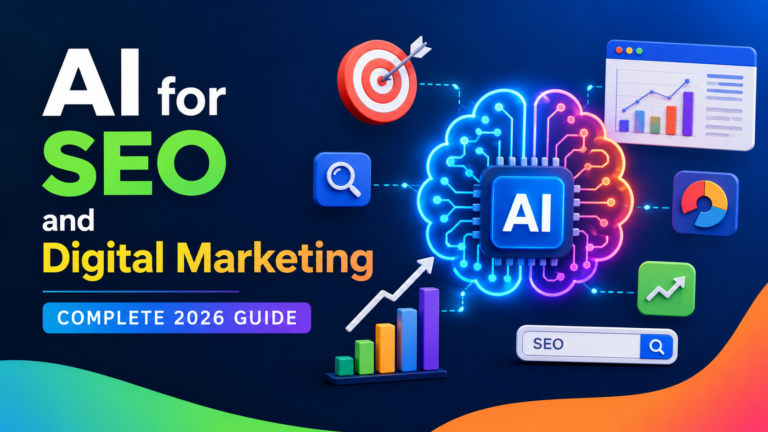
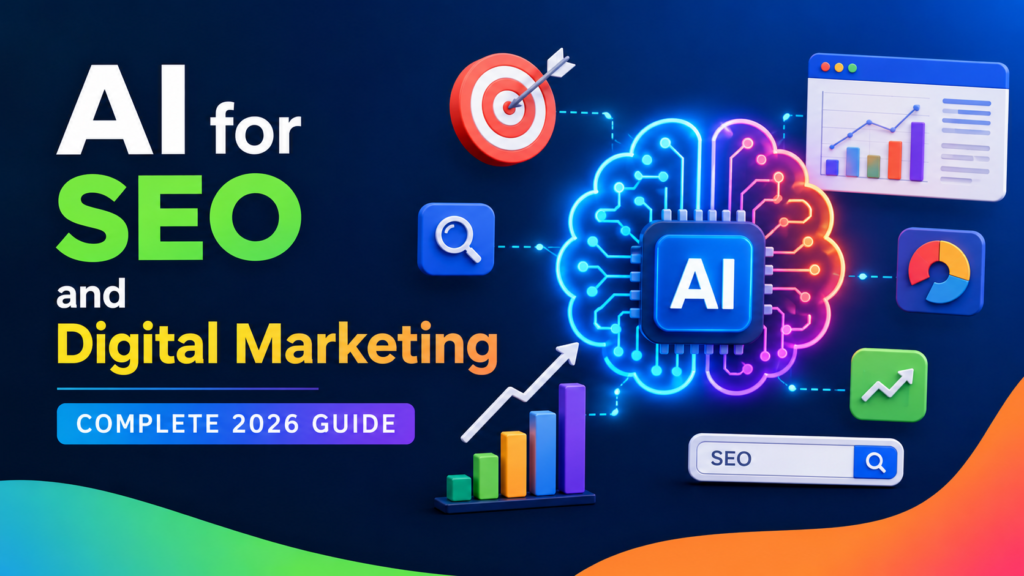

AI for SEO and Digital Marketing: The Complete Guide for 2026
What Is AI for SEO and Digital Marketing?
Artificial intelligence is rapidly changing how businesses approach search engine optimization and digital marketing. Instead of relying solely on manual research and repetitive tasks, marketers can now use AI-powered tools to analyze data, identify trends, create content, and optimize campaigns more efficiently. AI helps brands understand customer behavior, improve decision-making, and deliver personalized experiences across multiple channels. As search engines become smarter and user expectations continue to evolve, AI is becoming an essential component of modern marketing strategies that aim to improve visibility, engagement, conversions, and long-term business growth.
Understanding Artificial Intelligence in Marketing
Artificial intelligence in marketing refers to the use of machine learning, natural language processing, and predictive analytics to automate and enhance marketing activities. AI systems can analyze massive amounts of customer data, identify patterns, and generate valuable insights. Businesses use AI to personalize content, improve audience targeting, automate workflows, and optimize customer journeys. These capabilities help marketers work smarter while delivering more relevant experiences.
How AI Is Transforming Search and Customer Acquisition
AI is reshaping the way users search for information and how businesses attract customers. Modern search engines use advanced algorithms to understand context, intent, and user behavior. AI-powered platforms can identify high-converting opportunities, predict customer needs, and automate lead generation efforts. This allows businesses to connect with the right audience at the right time, improving acquisition costs and increasing conversion rates across digital channels.
AI vs Traditional SEO and Marketing Approaches
Traditional SEO and marketing often rely on manual analysis, guesswork, and time-consuming processes. AI introduces automation, deeper insights, and faster execution. While conventional methods still play an important role, AI can process data at a scale humans cannot match. This combination enables marketers to uncover opportunities, optimize campaigns more effectively, and adapt quickly to changing search engine algorithms and consumer behaviors.
💚 You might also like: Latest Robotics Innovations Powered by AI in 2026
Benefits of Using AI in SEO and Digital Marketing
The adoption of AI offers significant advantages for businesses of all sizes. From improving productivity to enhancing customer experiences, AI enables marketers to achieve better results while reducing manual effort. According to research from McKinsey, organizations that effectively implement AI often report measurable improvements in operational efficiency and revenue growth. AI can automate repetitive tasks, provide actionable insights, improve audience segmentation, and support data-driven strategies. These benefits help businesses stay competitive in increasingly crowded digital markets while maximizing the value of their marketing investments.
Improved Efficiency and Automation
AI automates repetitive tasks such as keyword research, content optimization, reporting, and audience segmentation. This allows marketing teams to focus on strategy and creativity instead of spending hours on manual processes. Automation also reduces human error and ensures greater consistency across campaigns, helping businesses operate more efficiently while scaling their marketing efforts.
Data-Driven Decision Making
One of AI’s greatest strengths is its ability to analyze large datasets quickly and accurately. Marketers can use AI-generated insights to identify opportunities, evaluate performance, and predict future trends. Instead of relying on assumptions, businesses can make informed decisions backed by real-time data, improving campaign effectiveness and overall marketing outcomes.
Better Personalization and User Experience
Consumers increasingly expect personalized experiences from brands. AI helps businesses analyze user behavior, preferences, and engagement patterns to deliver relevant content and recommendations. Personalized experiences improve customer satisfaction, strengthen brand loyalty, and increase engagement rates. As a result, businesses can build stronger relationships with their audiences while improving conversion performance.
Increased ROI and Marketing Performance
AI improves return on investment by helping marketers allocate resources more effectively and optimize campaigns in real time. Predictive analytics, audience targeting, and automated optimization reduce wasted spending while increasing efficiency. Businesses that leverage AI effectively often achieve higher conversion rates, lower acquisition costs, and stronger overall marketing performance compared to traditional approaches.
How AI Improves Keyword Research and Search Intent Analysis
Keyword research remains the foundation of successful SEO, but AI has significantly enhanced the process. Modern AI tools can analyze millions of search queries, identify emerging trends, and uncover valuable keyword opportunities in seconds. Beyond simple keyword discovery, AI helps marketers understand search intent, group related topics, and predict future demand patterns. These capabilities enable businesses to create content that aligns closely with user needs and search engine expectations, improving rankings, organic traffic, and overall content relevance.
Finding High-Value Keywords Faster
AI-powered keyword research tools can process vast amounts of search data to identify profitable opportunities quickly. Instead of manually reviewing hundreds of keywords, marketers can discover relevant terms based on competition, search volume, and intent. This saves time and helps businesses focus on keywords that offer the greatest potential for traffic and conversions.
Understanding Search Intent with AI
Search intent plays a critical role in modern SEO. AI can analyze user behavior and query patterns to determine whether searchers are looking for information, products, services, or solutions. By understanding intent more accurately, marketers can create content that directly addresses user needs, resulting in better engagement, rankings, and conversion rates.
Semantic Keyword Clustering
AI tools can organize related keywords into semantic clusters based on topic relevance and contextual relationships. This approach helps businesses build topical authority by covering subjects comprehensively rather than targeting isolated keywords. Semantic clustering also improves internal linking strategies and supports the creation of content that aligns with modern search engine algorithms.
Predictive Trend Analysis
AI can identify emerging search trends before they become highly competitive. By analyzing historical data, seasonal patterns, and market signals, AI helps marketers anticipate future demand. This allows businesses to publish relevant content early, gain visibility ahead of competitors, and capitalize on new opportunities before they become saturated.
💚 You might also like: Best ChatGPT Alternatives in 2026 | Top AI Chatbots
Best AI Tools for SEO and Digital Marketing in 2026
The AI software market continues to expand rapidly, giving marketers access to tools that improve efficiency, content quality, analytics, and campaign performance. According to Statista, the global AI market is expected to surpass $800 billion by the end of the decade, reflecting widespread adoption across industries. For SEO and digital marketing professionals, AI tools can automate keyword research, optimize content, improve audience targeting, and uncover valuable insights from large datasets. Choosing the right solution depends on business goals, budget, integration capabilities, and the specific marketing challenges an organization wants to solve.
AI SEO Tools
AI SEO tools help marketers streamline keyword research, content optimization, technical audits, and competitive analysis. Platforms such as Semrush, Ahrefs, and Surfer SEO use artificial intelligence to identify ranking opportunities and improve search visibility. These tools save time by automating data analysis while helping marketers make smarter decisions based on search trends and performance metrics.
AI Content Marketing Tools
Content marketing platforms powered by AI assist with brainstorming, outlining, writing, editing, and optimization. These tools help marketers produce content more efficiently while maintaining quality standards. AI can also recommend topics, identify content gaps, and suggest improvements based on audience behavior. This enables businesses to publish relevant content that attracts and engages potential customers.
AI Analytics and Automation Platforms
AI analytics platforms process large volumes of data to uncover patterns and actionable insights. Marketing automation systems use these insights to personalize campaigns, optimize customer journeys, and improve lead nurturing. Businesses can monitor performance in real time, automate repetitive tasks, and make faster decisions that support growth while improving customer engagement across multiple channels.
Criteria for Choosing the Right AI Tool
Selecting the right AI tool requires careful evaluation. Businesses should consider accuracy, scalability, ease of use, integration options, security standards, and customer support. It is also important to assess whether a tool aligns with marketing objectives and delivers measurable value. A thoughtful selection process helps organizations maximize return on investment and avoid unnecessary complexity.
AI SEO Strategies for Ranking in Google and AI Search Engines
Search behavior is evolving as AI-powered search engines become more sophisticated. Traditional SEO remains important, but businesses must also optimize for AI-generated search experiences. Modern strategies focus on topical authority, structured information, user intent, and content quality. Google’s AI Overviews and emerging AI search platforms increasingly prioritize content that demonstrates expertise, trustworthiness, and relevance. Businesses that adapt to these changes can improve visibility across both traditional search results and AI-generated answers while building long-term authority in competitive markets.
Optimizing for Google AI Overviews
Google AI Overviews aim to provide direct answers by summarizing information from multiple trusted sources. To improve visibility, businesses should create clear, well-structured content that directly addresses user questions. Using headings, concise explanations, supporting data, and authoritative references increases the likelihood that content will be selected and featured within AI-generated search summaries.
Generative Engine Optimization (GEO)
Generative Engine Optimization focuses on improving visibility within AI-powered search platforms that generate conversational responses. GEO emphasizes comprehensive content, entity optimization, semantic relevance, and topical depth. Instead of targeting isolated keywords, businesses create content ecosystems that help AI systems understand expertise, context, and subject authority across an entire website.
Answer Engine Optimization (AEO)
Answer Engine Optimization is designed to help content appear in featured snippets, voice search results, and AI-generated responses. AEO involves providing direct answers, using question-based content structures, and organizing information logically. By addressing common user queries clearly, businesses can improve visibility and increase the chances of becoming a trusted source of information.
Building Topical Authority with AI
AI can help marketers identify content gaps, map topic clusters, and develop comprehensive content strategies. Building topical authority requires covering a subject in depth through interconnected articles and supporting resources. Search engines increasingly reward websites that demonstrate expertise across an entire topic rather than focusing solely on individual keywords or isolated content pieces.
💚 You might also like: The Future of Robotics and Artificial Intelligence
Challenges and Limitations of AI in SEO and Digital Marketing
While AI offers significant advantages, it is not without limitations. Businesses must understand both the opportunities and risks associated with AI adoption. Challenges include accuracy issues, over-reliance on automation, content quality concerns, and evolving privacy regulations. Effective use of AI requires human oversight, strategic thinking, and ongoing quality control. Organizations that balance automation with expert judgment can minimize risks while benefiting from AI-driven efficiency. Understanding these limitations is essential for building sustainable marketing strategies that maintain credibility, trust, and long-term performance.
Accuracy and Hallucination Risks
AI systems occasionally generate incorrect or misleading information, commonly known as hallucinations. These inaccuracies can affect content quality and damage brand credibility if left unchecked. Businesses should verify facts, review AI-generated outputs carefully, and rely on trusted sources when publishing information. Human oversight remains critical for maintaining accuracy and reliability.
Over-Reliance on Automation
Automation improves efficiency, but excessive dependence on AI can create challenges. Marketing strategies still require creativity, critical thinking, and human understanding of customer behavior. Businesses that rely entirely on automation may overlook important nuances, market shifts, and audience preferences. A balanced approach produces stronger results than automation alone.
Content Quality Concerns
AI can generate content quickly, but speed does not always guarantee quality. Poorly edited AI-generated content may lack originality, depth, and authenticity. Search engines increasingly prioritize helpful content that demonstrates expertise and value. Businesses should combine AI capabilities with human editing to ensure content meets quality standards and user expectations.
Ethical and Privacy Considerations
AI adoption raises important questions regarding data privacy, transparency, and ethical use. Businesses must comply with regulations and handle customer information responsibly. Transparency about AI-generated content and responsible data practices help maintain trust. Ethical AI implementation supports long-term brand reputation while reducing legal and operational risks.
💚 You might also like: AI and Security Automation for Cyber Defense
The Future of AI for SEO and Digital Marketing
AI is expected to play an even larger role in the future of SEO and digital marketing. Advancements in machine learning, automation, predictive analytics, and natural language understanding will continue to reshape how businesses connect with audiences. Industry analysts predict increasing adoption of AI-driven personalization and autonomous marketing systems. As technology evolves, organizations that embrace innovation while maintaining human oversight will be better positioned to adapt to changing consumer expectations. The future belongs to businesses that combine advanced technology with authentic customer-focused marketing strategies.
Emerging AI Marketing Trends
Several trends are shaping the future of digital marketing, including predictive personalization, conversational AI, advanced analytics, and multimodal search experiences. Businesses are increasingly using AI to understand customer behavior and deliver highly relevant experiences. These innovations create opportunities for stronger engagement, better targeting, and improved marketing performance across channels.
Agentic AI and Marketing Automation
Agentic AI represents a new generation of systems capable of performing complex tasks with minimal human intervention. These technologies can manage workflows, optimize campaigns, and make recommendations based on real-time data. As agentic AI matures, businesses may achieve greater efficiency while freeing teams to focus on strategic initiatives.
AI-Powered Search Experiences
Search experiences are becoming more conversational, personalized, and context-aware. AI-powered search engines increasingly provide direct answers rather than simple lists of links. Businesses must adapt by creating comprehensive, trustworthy content that satisfies user intent. Success in future search environments will depend on relevance, authority, and information quality.
How Businesses Can Prepare for the Future
Organizations can prepare for future AI developments by investing in skills, technology, and data infrastructure. Continuous learning, experimentation, and strategic planning are essential. Businesses should focus on creating high-quality content, improving data management practices, and staying informed about industry trends to remain competitive in evolving digital markets.
Conclusion
Artificial intelligence has transformed SEO and digital marketing from data-heavy, manual disciplines into highly intelligent and efficient processes. From keyword research and content creation to analytics and automation, AI enables businesses to make smarter decisions and deliver better customer experiences. However, success depends on combining AI capabilities with human expertise. Organizations that use AI responsibly, focus on quality, and adapt to emerging search technologies will be better positioned to increase visibility, attract qualified traffic, and achieve sustainable growth in an increasingly competitive digital landscape.
Key Takeaways
AI enhances SEO and digital marketing through automation, personalization, analytics, and optimization. Businesses can improve efficiency, discover new opportunities, and create better user experiences. However, human oversight remains essential for maintaining quality, accuracy, and strategic direction. The most successful organizations combine technology with expertise to maximize long-term results.
Actionable Steps to Implement AI in Your SEO and Marketing Strategy
Start by identifying repetitive tasks that can be automated using AI tools. Use AI for keyword research, content optimization, audience analysis, and reporting. Monitor results regularly, validate information, and refine strategies based on performance data. Combining AI insights with human creativity creates a more effective and sustainable marketing approach.
Frequently Asked Questions
How is AI used in SEO?
AI is used for keyword research, content optimization, technical audits, competitor analysis, search intent evaluation, and predictive analytics. It helps marketers improve efficiency while making data-driven decisions that support better search visibility.
Can AI improve Google rankings?
AI can support higher rankings by helping marketers create better content, optimize websites, and identify opportunities. However, rankings still depend on content quality, relevance, authority, user experience, and adherence to search engine guidelines.
What are the best AI tools for digital marketing?
Popular AI marketing tools include Semrush, Ahrefs, Surfer SEO, ChatGPT, Jasper, HubSpot, and Google Analytics. The best choice depends on business objectives, budget, and required features.
Is AI-generated content good for SEO?
AI-generated content can perform well when it is accurate, valuable, and properly edited. Search engines prioritize helpful content rather than the method used to create it. Human review remains essential for quality assurance.
What is GEO and AEO in SEO?
GEO stands for Generative Engine Optimization, which focuses on visibility in AI-powered search platforms. AEO stands for Answer Engine Optimization, which helps content appear in direct answers, snippets, voice search, and AI-generated responses.
Will AI replace SEO professionals?
AI is unlikely to replace SEO professionals completely. Instead, it will change how they work by automating repetitive tasks and providing deeper insights. Human expertise remains essential for strategy, creativity, and decision-making.
✨ Smart minds follow smart pages, hit follow on AI Mastars.