

What Is Muke AI? A Detailed Guide in 2026
Artificial intelligence tools are launching almost daily, but only a few manage to spark real curiosity across search engines and online communities. Muke AI is one of those names that has quietly gained attention, prompting users to ask a simple but important question: What exactly is Muke AI, and why are people searching for it?
In this guide, we’ll break down what Muke AI is, why it exists, and how it works, without hype or technical overload.
What Is Muke AI?
Muke AI is an AI-powered online platform primarily associated with image processing and transformation tools. Most users discover it while searching for advanced AI image editing features, such as automated transformations, visual enhancements, or AI-assisted image manipulation.
Unlike enterprise-level AI platforms built for developers or businesses, Muke AI positions itself as a direct-to-user tool, meaning it focuses on accessibility rather than complex technical setups. The platform is web-based, requires no software installation, and is designed for quick interactions rather than long creative workflows.
From a search intent perspective, people looking for Muke AI usually fall into three categories:
Users curious about AI image editing tools
People researching new or trending AI platforms
Individuals are trying to determine whether Muke AI is legitimate and safe
Understanding this intent is essential because it explains why informational content about Muke AI consistently performs better than purely promotional pages.
The Purpose Behind Muke AI
At its core, Muke AI aims to simplify AI-powered visual processing. The platform focuses on reducing the technical gap between complex machine-learning models and everyday users who want fast results.
Instead of requiring prompts with advanced parameters or design experience, Muke AI generally follows a straightforward approach:
Upload an image
Select a processing option
Let the AI generate the result
This simplicity is a major reason why platforms like Muke AI gain attention quickly, especially among users who are new to AI tools and want immediate outcomes without a learning curve.
Core Capabilities of Muke AI
While Muke AI’s exact feature set may evolve, its primary capabilities revolve around AI-driven image manipulation. These commonly include:
Automated image transformation
AI-based facial or visual adjustments
Image enhancement or stylization
Rapid processing with minimal user input
The platform emphasizes speed and ease of use rather than deep customization. For many users, that trade-off is acceptable, especially when the goal is quick experimentation rather than professional-grade design work.
How Muke AI Works (A Simplified Breakdown)
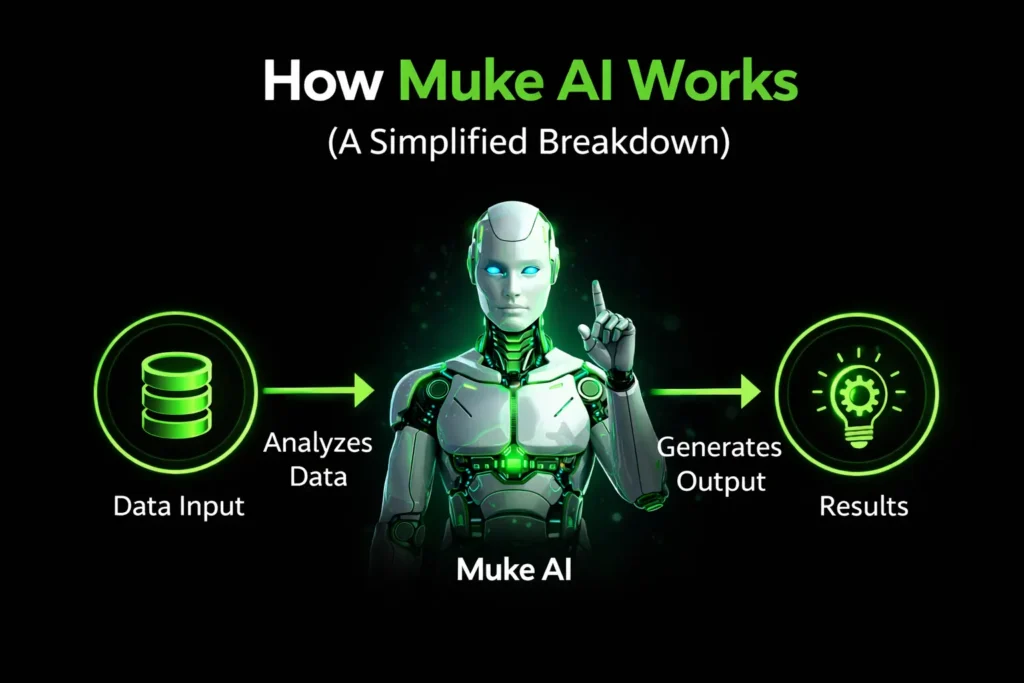
Understanding how Muke AI works doesn’t require a background in artificial intelligence. The platform follows a standard AI image-processing pipeline that most modern tools rely on.
Step 1: Image Upload
Users begin by uploading an image directly through the browser. The process is designed to be fast, with support for common file formats such as JPG and PNG.
Step 2: AI Processing
Once uploaded, the image is processed through trained AI models. These models analyze visual elements such as shapes, facial features, textures, and lighting, depending on the selected tool or function.
Step 3: Output Generation
After processing, the AI generates a modified version of the image. This output is typically available within seconds, reinforcing the platform’s emphasis on speed.
This three-step flow explains why Muke AI appeals to casual users—it removes friction and keeps the experience intuitive.
User Interface and Overall Experience
Clean and Minimal Design
One of the first things users notice about Muke AI is its minimal interface. There are no complex dashboards, layered menus, or advanced configuration panels. Everything is built around quick interaction.
Beginner-Friendly Layout
Buttons, upload fields, and action prompts are designed to be self-explanatory. This makes the platform accessible even to users who have never interacted with AI tools before.
Low Barrier to Entry
No advanced hardware, plugins, or design software is required. As long as you have a modern browser and an internet connection, Muke AI is usable.
This usability-first approach aligns with current trends in AI adoption, where simplicity often matters more than technical depth.
Processing Speed and Output Quality
Muke AI emphasizes fast turnaround times, often delivering results within seconds. For users testing ideas, exploring AI capabilities, or experimenting with images, this speed is a key advantage.
In terms of quality, the output generally reflects what you’d expect from lightweight AI tools:
Suitable for experimentation and casual use
Not always consistent across complex images
Best results with clear, high-quality input images
Understanding these limitations helps set realistic expectations, which is essential for user satisfaction.
Supported Formats and Accessibility
Muke AI supports widely used image formats, ensuring compatibility across devices and platforms. The web-based nature of the tool means it works on desktops, laptops, and even mobile browsers in many cases.
This cross-platform accessibility contributes to its growing visibility in search results, especially among users who prefer not to download additional software.
Why Muke AI Is Gaining Attention
Muke AI stands out not because it reinvents artificial intelligence, but because it reflects a broader shift in how AI tools are consumed:
Faster results
Fewer technical barriers
Immediate experimentation
These qualities explain why users continue searching for terms like “Muke AI review,” “what is Muke AI,” and “is Muke AI safe.”
User Experience: What It’s Like to Use Muke AI
One of the most noticeable aspects of Muke AI is how quickly users can start using it. There’s little to no onboarding friction, which plays a major role in first impressions.
Simple Access, Minimal Setup
Users typically don’t need to install software or configure settings. This instant accessibility appeals to people who want quick results rather than a long setup process.
Straightforward Workflow
The platform follows a predictable pattern:
Upload content
Select an option
Receive output
This workflow removes guesswork, making it especially attractive to users who may feel overwhelmed by feature-heavy AI platforms.
Who This Experience Works Best For
Muke AI’s user experience is best suited for:
Casual users experimenting with AI
Creators looking for quick visual outputs
People testing ideas rather than producing final assets
For advanced users seeking granular control, the experience may feel limited, but that limitation is intentional.
Feature Deep Dive: What Does Muke AI Actually Offer?
Rather than overwhelming users with dozens of tools, Muke AI focuses on a small set of AI-driven visual features.
AI Image Processing Tools
The core functionality revolves around automated image manipulation. This includes visual adjustments driven by machine learning models trained to recognize patterns, faces, and textures.
While results vary depending on image quality, the AI generally performs best with:
Clear lighting
High-resolution images
Minimal visual noise
Speed Over Precision
One recurring theme in user feedback is speed. Muke AI prioritizes fast output rather than pixel-perfect accuracy. For exploratory use, this trade-off often makes sense.
Limited Customization
Unlike professional-grade tools, Muke AI doesn’t offer deep sliders, advanced prompt engineering, or layered edits. This can be a downside for designers, but a plus for beginners.
Perceived Strengths of Muke AI
Based on user behavior and platform positioning, several strengths stand out.
Low Learning Curve
Most users can use Muke AI within minutes. No tutorials, documentation deep-dives, or AI knowledge is required.
Fast Results
The ability to generate outputs quickly makes Muke AI suitable for rapid testing and experimentation.
Web-Based Convenience
Because it runs entirely in the browser, users don’t need powerful hardware or specialized devices.
Limitations and Weak Points
No tool is without flaws, and Muke AI is no exception.
Lack of Transparency
One common concern among users is limited information about:
How data is handled
How long uploads are stored
Who operates the platform
While this doesn’t automatically make a tool unsafe, it does raise reasonable questions, especially for users dealing with personal images.
Inconsistent Output Quality
Results can vary depending on the input image. Some outputs look surprisingly effective, while others feel underwhelming.
Not Built for Professional Workflows
Muke AI is not a replacement for professional image-editing software or advanced AI generators. It fills a different niche.
Muke AI vs Other AI Image Tools
To better understand Muke AI’s position, it helps to compare it with more established platforms.
Muke AI vs Midjourney
Midjourney offers artistic depth and creative control
Muke AI offers simplicity and speed
Midjourney excels in creativity, while Muke AI focuses on ease of use.
Muke AI vs DALL·E
DALL·E is prompt-based and concept-driven
Muke AI is upload-based and transformation-driven
This difference means Muke AI is more about modifying existing visuals than generating new ones from text.
Muke AI vs Adobe Firefly
Adobe Firefly integrates deeply with professional design workflows. Muke AI, by contrast, targets casual or exploratory users who want quick outcomes without subscriptions or complex tools.
SEO Perspective: Why Muke AI Gets Traffic
From an SEO standpoint, Muke AI benefits from several factors:
- Rising interest in AI image tools
- Curiosity-driven search behavior
- Users looking for alternatives to mainstream platforms
Search queries like “Muke AI review,” “how does Muke AI work,” and “Muke AI alternative” reflect informational intent rather than purchasing intent, making in-depth content particularly valuable.
Who Should Consider Using Muke AI?
Muke AI is most suitable for users experimenting with AI visuals, people exploring new AI platforms, and creators needing quick drafts or concept previews.
It may not be ideal for:
Professional designers
Businesses handling sensitive user data
Projects requiring consistent, high-end outputs
Understanding this distinction helps users avoid unrealistic expectations.
The Bigger Picture: Where Muke AI Fits
Muke AI represents a growing category of lightweight AI tools designed for accessibility rather than mastery. These platforms don’t aim to replace industry leaders, they aim to introduce AI to a wider audience.
Is Muke AI Legit? Understanding Its Online Reputation

Muke AI exists as a functional platform and delivers results, which means it is not a fake or non-operational website. However, legitimacy goes beyond functionality.
What Legitimacy Means in AI Tools
A legitimate AI platform typically offers:
Clear company or developer information
Transparent terms of service
Defined privacy and data handling policies
Muke AI operates in a more anonymous or low-transparency manner, which places it in a gray area. This does not automatically make it unsafe, but it does mean users should proceed with awareness.
Why This Matters
When AI platforms handle user-uploaded images, transparency becomes critical. Users deserve clarity about:
Whether images are stored
How long data is retained
Whether content is used for training AI models
The absence of detailed disclosures is one of the most frequently discussed concerns around Muke AI.
Privacy and Data Security Concerns
Image Upload Risks
Any AI tool that requires image uploads introduces potential privacy risks. With Muke AI, users often question what happens to their images after processing.
Without clear public documentation, best practice is to assume:
Uploaded images may be temporarily stored
Data handling policies may change without notice
Best Practices for Users
If you choose to use Muke AI:
Avoid uploading personal or identifiable photos
Do not use sensitive or private images
Treat the platform as experimental rather than permanent
This approach significantly reduces risk.
Ethical Considerations Surrounding Muke AI
Ethics is one of the most critical discussions around modern AI platforms and Muke AI is no exception.
Potential for Misuse
AI image tools can be misused when:
Images are altered without consent
Visual content is manipulated deceptively
People are misrepresented or exploited
While Muke AI is a tool, responsibility lies with the user. Ethical use should always involve consent, transparency, and respect.
Why Ethical Awareness Matters
Search engines and regulators are increasingly focused on ethical AI usage. Platforms that ignore these concerns often face reputational damage or legal challenges over time.
Being an informed user is not just safer, it’s future-proof.
Legal Implications You Should Be Aware Of
AI laws vary by region, but several principles are becoming universal:
Using someone’s image without permission can violate privacy laws
Distributing manipulated images can have legal consequences
Uploading copyrighted content may breach usage rights
Muke AI does not replace legal responsibility. Users remain accountable for how they use the outputs.
Who Should Use Muke AI and Who Should Avoid It
Muke AI Is Suitable For:
Casual experimentation
Learning how AI image tools work
Non-sensitive creative exploration
Muke AI Is NOT Ideal For:
Professional commercial projects
Handling private or client data
Long-term content production pipelines
Understanding this distinction prevents disappointment and risk.
Final Verdict: Is Muke AI Worth Trying?
Muke AI is best described as a lightweight, experimental AI image tool. It excels in accessibility and speed but lacks the transparency and robustness expected from enterprise-grade platforms.
Pros:
Easy to use
Fast output
No technical knowledge required
Cons:
Limited transparency
Ethical and privacy concerns
Inconsistent output quality
Verdict: Muke AI can be explored cautiously for experimentation, but it should not be relied upon for sensitive, professional, or long-term use.
Conclusion
Muke AI reflects a broader trend in artificial intelligence: tools are becoming faster, simpler, and more accessible, but not always more transparent.
If you approach Muke AI with clear expectations, ethical awareness, and basic privacy precautions, it can be an interesting platform to explore. However, users seeking reliability, accountability, and professional-grade results may find better alternatives elsewhere.
The key takeaway is simple: Use curiosity, not blind trust, when experimenting with emerging AI tools.
Frequently Asked Questions (FAQs)
Is Muke AI safe to use?
Muke AI works as intended, but due to limited transparency, users should avoid uploading personal or sensitive images.
Does Muke AI store uploaded images?
There is no publicly detailed confirmation. It’s safest to assume temporary storage may occur.
Is Muke AI free or paid?
Access models may vary. Users should review the platform directly for current pricing or limitations.
Can Muke AI be used for commercial projects?
It is not recommended due to unclear licensing, privacy, and data usage terms.
Are there ethical risks with Muke AI?
Yes. Like many AI image tools, misuse can lead to ethical and legal issues if consent and responsibility are ignored.
What are safer alternatives to Muke AI?
Established platforms with clear policies, transparent ownership, and ethical guidelines are generally safer for professional use.
👉 You’re one follow away from daily smarter thinking, follow AI Mastars.